

CASE STUDY 3
Activations: The Alexandra River Creatures: Combining Community, Art and the Environment
“Ecological systems are part of the city’s public realm. When communities care for their river, they are practising urban regeneration.”

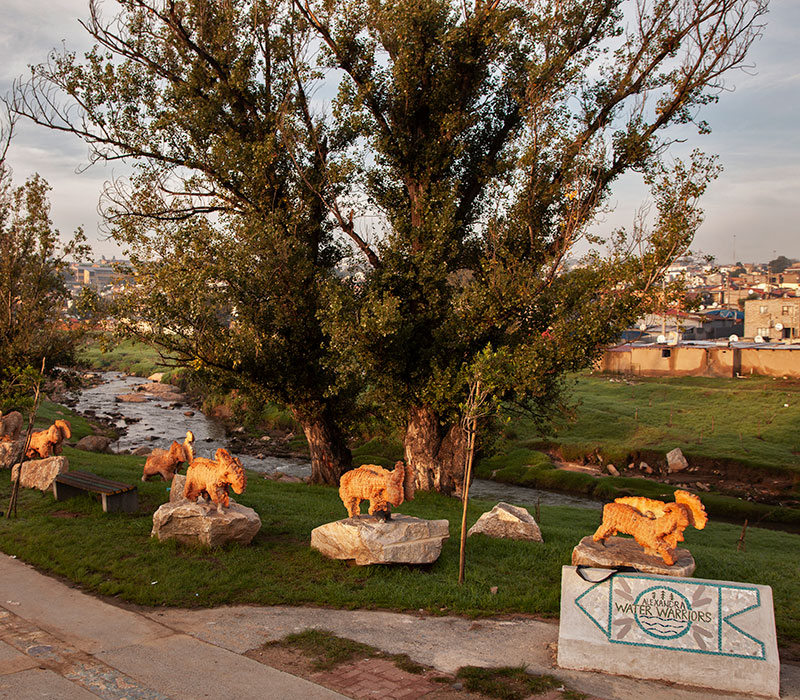
For years, sections of the Jukskei River have carried accumulated litter and debris, increasing flood risk and undermining ecological functions. In many stretches, the riverbank offers no sense of amenity or identity, despite being central to community life.
The idea of combining functional litter traps with public art emerged during a site visit by the JICP to the river with the Alexandra Water Warriors, a JICP partner actively involved in local river stewardship. Observing both the scale of the pollution and the commitment of residents working to protect the river, JICP conceptualised an approach where waste-harvesting infrastructure could also serve as visible civic landmarks.
Through the SUNCASA programme, and in collaboration with artist and researcher Hannelie Coetzee, the Alexandra Water Warriors and local residents, this concept evolved into the Alexandra River Creatures.
Community workshops identified locally resonant animals as symbols of the river ecosystem. These included Izizwe the bird, Musa the goat, Nhlakanipho the crab and Mkhuseli the mongoose, and a river fish litter trap. These species were selected by community members, grounding the installations in local narrative and identity.
Constructed from reclaimed materials and debris associated with river pollution, the sculptures function as working litter traps and public artworks. They capture waste while transforming harvested materials into mosaic signage and educational elements that tell the story of ecological care and restoration.
The installations reduce solid waste loads and contribute to lower flood peaks while attracting renewed pedestrian activity along the river corridor. By embedding artistic, low-tech infrastructure within nature-based solutions, the project demonstrates that public space activation can deliver ecological benefit while strengthening long-term social ownership.
Through this work, the JICP is expanding the meaning of public space activation. Activation is not only about events or programming. It is about restoring dignity, identity and stewardship to the full spectrum of public realm — including the river itself.
