

Social Employment Fund
Work for the common good
The Social Employment Fund is one of JICP’s most important people-based regeneration programmes. It connects employment creation with practical work that improves the daily life of Johannesburg’s inner city.
Through the national Social Employment Fund, administered by the Industrial Development Corporation, participants are supported through part-time work opportunities focused on public benefit. For JICP, this is not only about job creation. It is about using employment as a platform to care for public spaces, support communities, build local capacity and create visible improvement where it matters most.
JICP has been a Strategic Implementing Partner in the Social Employment Fund since the early stages of the programme. In the Johannesburg inner city, our SEF work is focused on two core areas: public space activation and creation, and waste management. These are supported by deliberate spatial planning, with much of the work aligned on the Walkable Network.

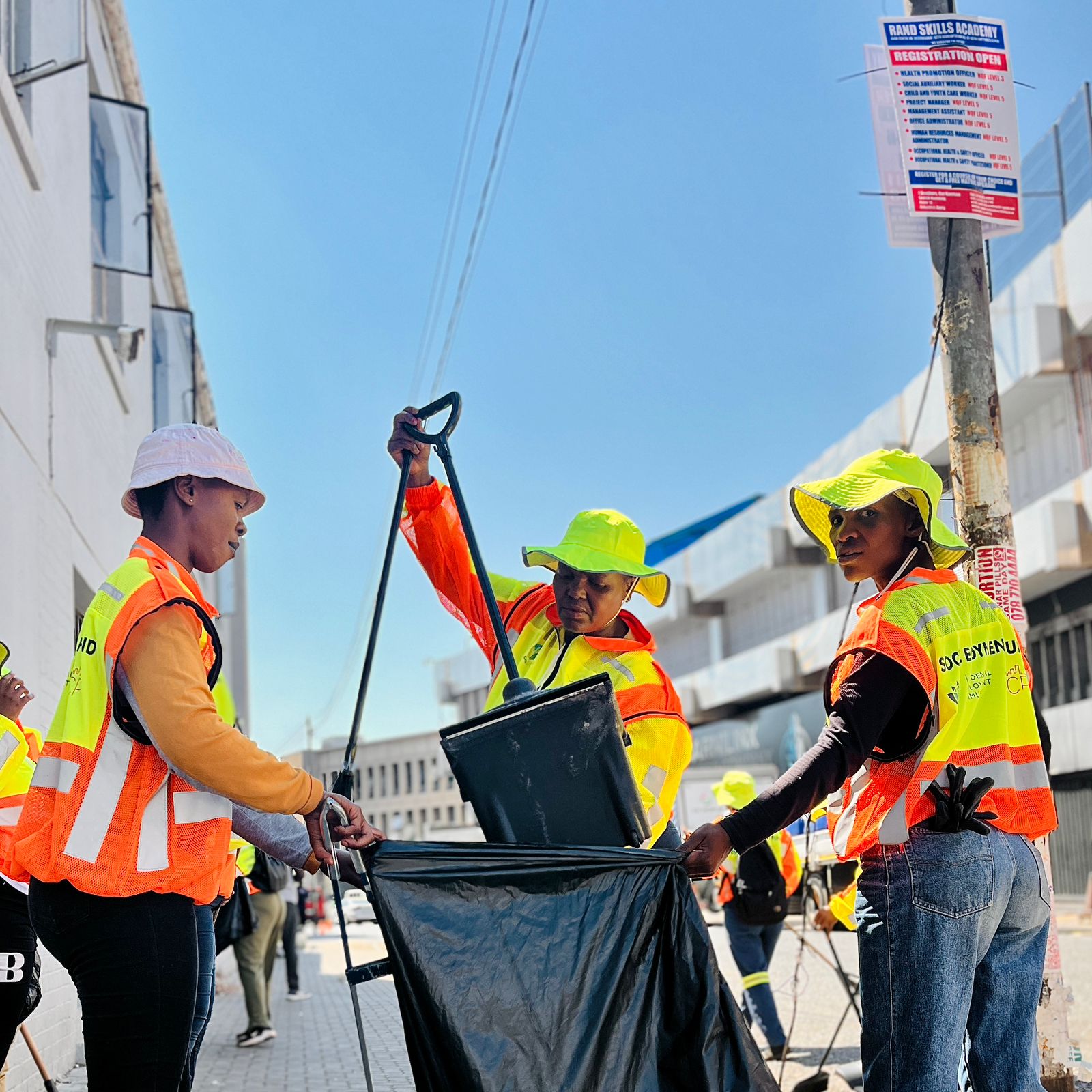
The challenge
Johannesburg’s inner city faces two connected challenges.
The first is unemployment. Many residents need access to income, work experience, skills development and pathways into future opportunity.
The second is the condition of the public realm. Streets, parks, civic spaces and shared facilities need daily care, maintenance, activation and stewardship if they are to become safer, cleaner and more welcoming.
The Social Employment Fund allows JICP and its partners to respond to both challenges at the same time. Participants earn an income while doing work that benefits the wider community. Public spaces improve, and people gain experience, confidence and a stronger connection to the places where they live and work.
Our approach
JICP’s SEF model is built around people, place and partnership.
We work with and through community-based organisations, local partners and inner-city residents. This allows the programme to respond to real needs on the ground, while also building a shared sense of agency and ownership.
Our spatial approach is centred on the Walkable Network. By focusing teams and activities on priority routes, parks, streets and public spaces, the programme helps ensure that small actions accumulate into visible change. Cleaning, greening, recycling, placemaking, education support, food security, health, youth development and community safety become more powerful when they are connected to a broader regeneration strategy.
The programme is led by Lindokuhle Ngema, JICP’s SEF Programme Lead, through a structured implementation model that mobilises resources, supports partners, coordinates deployment, and ensures that work is aligned with both SEF objectives and inner-city priorities.
What this looks like on the ground
JICP’s SEF programme supports a wide range of work for the common good.
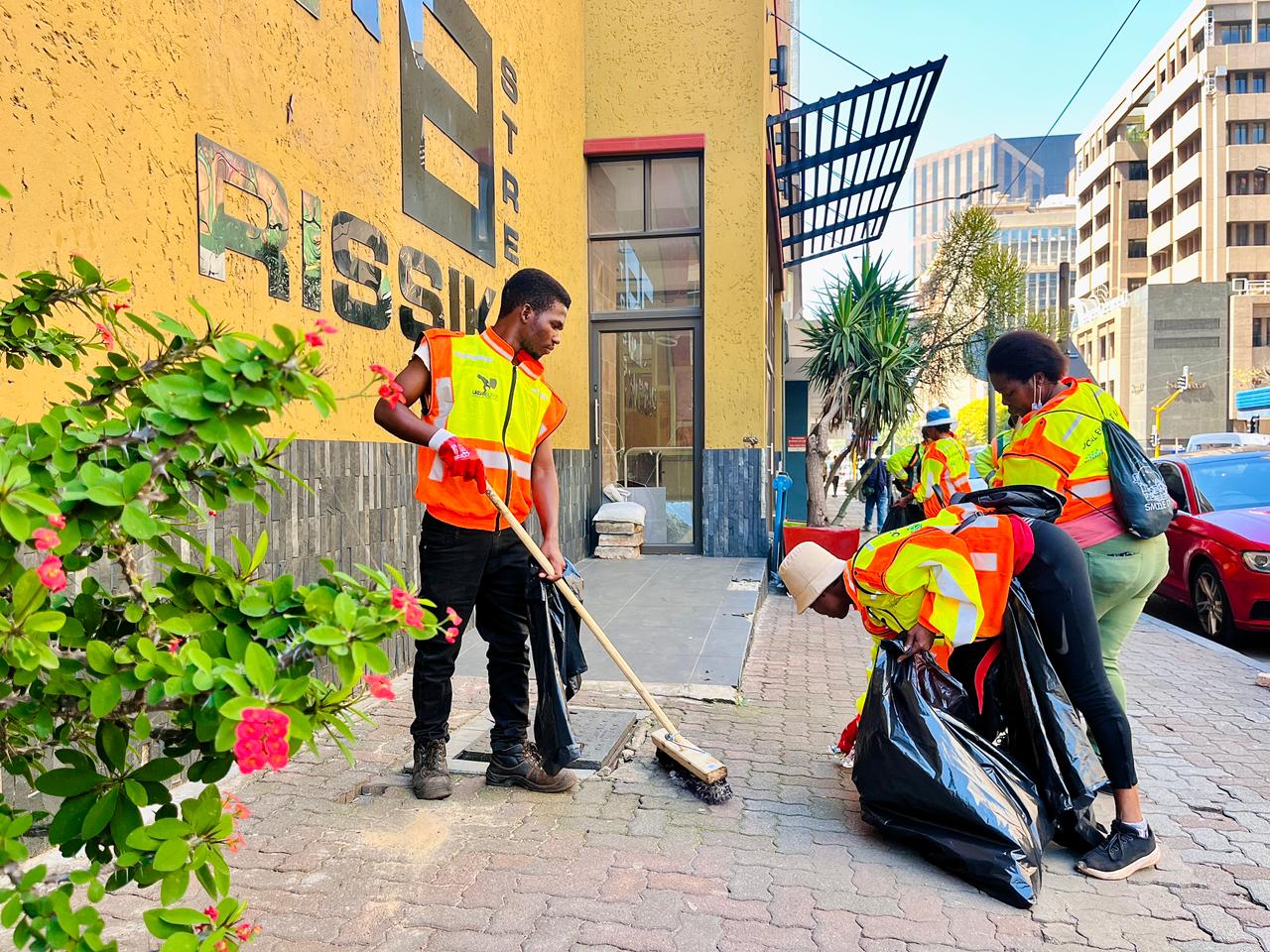
This includes cleaning, waste management and recycling; greening and environmental care; placemaking and public space activation; food security and nutrition; health and wellness; early childhood development and education support; arts, culture and community programming; youth support; micro-enterprise development; community safety; and action against gender-based violence.
Through these work streams, participants contribute to cleaner streets, more active public spaces, stronger community networks and a more liveable inner city.
JICP’s SEF teams also support broader urban management and regeneration efforts, including the G13 Campaigns in Johannesburg. While these campaigns take place at specific intervals,
JICP’s SEF work continues daily across inner-city precincts, helping to improve cleanliness, safety, functionality and public confidence.
Why it matters
The Social Employment Fund shows how employment can be more than temporary income support.
When properly organised, social employment can deliver public value. It can improve places, support vulnerable communities, strengthen local organisations and build pathways for participants into future work, training or enterprise opportunities.
For JICP, SEF is also a practical expression of people-based urban regeneration. It places residents and community organisations at the centre of inner-city improvement. It recognises that public spaces are not only upgraded through capital projects, but cared for through daily presence, participation and stewardship.
By linking employment creation with visible improvements in the public realm, the programme helps restore confidence in the inner city and supports the broader goal of a safer, cleaner, more inclusive and more walkable Johannesburg.
Implementation momentum
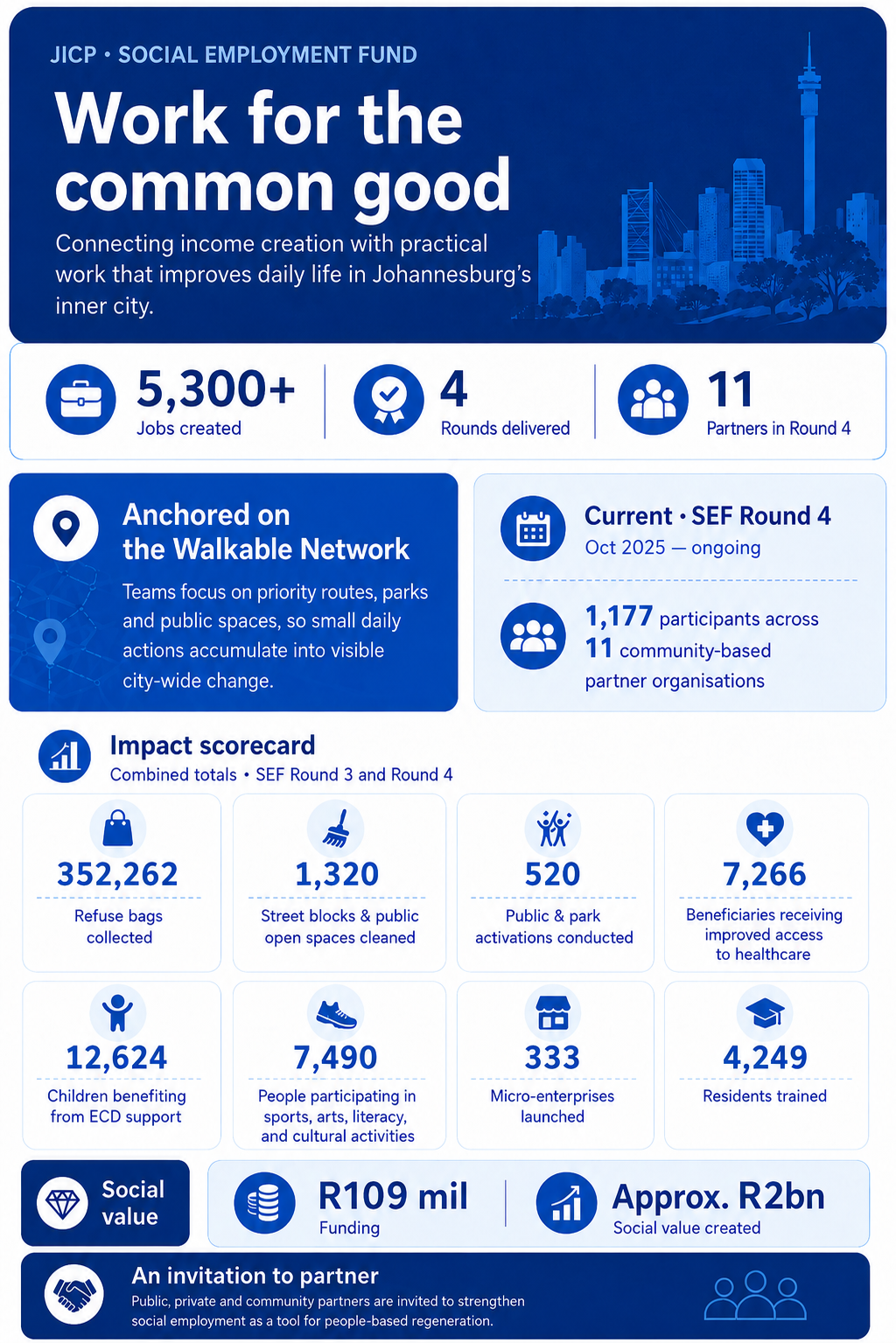
JICP has delivered more than 5,300 community-serving jobs across four rounds of the Social Employment Fund. The programme has also received international recognition, including the Prosperity Catalyst Award at the 2024 Bay Urban Visionary Awards in Bilbao, Spain.
For implementation, JICP established the Johannesburg Inner City Social Employment Programme as a dedicated vehicle to oversee and execute programme activities.
SEF Round 4 commenced in October 2025 with 11 partners and 1,177 participants. SEF Round 5 is scheduled to commence in September 2026 and will run over a 10-month period into 2027.
An invitation to partner
The Social Employment Fund works best when public, private and community partners align around shared priorities.
JICP invites partners, funders, government, businesses and community organisations to work with us in strengthening social employment as a tool for practical, people-based regeneration.
The opportunity is not only to create work. It is to create work that matters — work that improves the city, supports communities and helps build a more dignified future for Johannesburg’s inner city.