

SUNCASA Johannesburg
Nature-based solutions for a more resilient city
SUNCASA is a climate adaptation programme focused on using nature-based solutions to strengthen urban resilience, restore ecosystems and improve the quality of life in vulnerable communities.
In Johannesburg, SUNCASA focuses on the Upper Jukskei River catchment, one of the city’s most important and most pressured urban water systems. The project brings together environmental rehabilitation, community participation, climate adaptation and local work opportunities to help restore river systems, improve public spaces and reduce climate-related risks.
The programme is funded by Global Affairs Canada, with international project leadership and support from the International Institute for Sustainable Development and the World Resources Institute. In Johannesburg, implementation is supported through a partnership between the City of Johannesburg, Johannesburg City Parks and Zoo, Johannesburg Inner City Partnership, Alexandra Water Warriors, Water for the Future, Zutari and GenderCC.
The challenge
Johannesburg’s rivers, wetlands and public open spaces are under significant pressure.
Pollution, illegal dumping, invasive alien vegetation, degraded riverbanks, poor stormwater management and climate-related flooding all affect the health of the city’s natural systems.
These challenges are felt most sharply by vulnerable communities living in high-risk urban areas, where environmental degradation is closely linked to safety, health, livelihoods and dignity.
Climate change is making these pressures more urgent. Flooding, heat stress, water insecurity and biodiversity loss are no longer distant risks. They are already shaping the daily experience of people living and moving through the city.
SUNCASA responds to this challenge by treating nature as critical urban infrastructure.
Our approach
SUNCASA uses nature-based solutions to reduce climate risk while improving the places where people live, work and gather.
The Johannesburg component of the programme focuses on restoring and protecting the Upper Jukskei River catchment through river rehabilitation, wetland restoration, urban greening, tree planting, invasive vegetation clearing, waste removal, litter traps, ecological restoration and environmental education.
JICP plays a central coordinating and implementation role in the Johannesburg project. This includes project oversight, fund management, partner coordination, operational management, procurement support, reporting, stakeholder engagement and implementation monitoring.
The programme is also strongly community-driven. It supports the participation of women, young people, local organisations and community-based environmental partners in practical climate adaptation work. In this way, environmental restoration is connected to livelihoods, skills development, stewardship and local agency.
What this looks like on the ground
SUNCASA supports practical environmental work across targeted communities and public spaces.
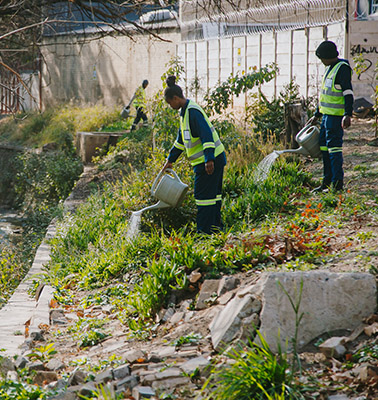
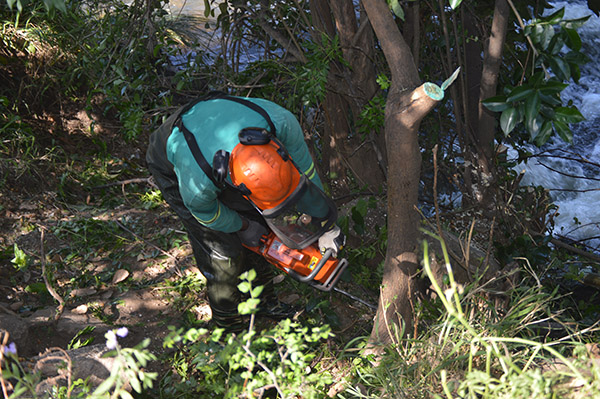
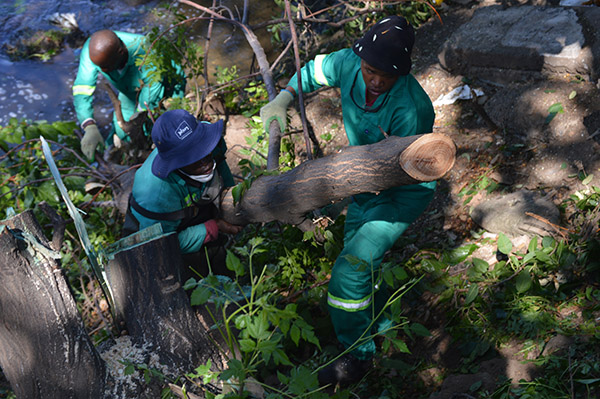
This includes clearing invasive alien vegetation, rehabilitating riverbanks, removing waste from river systems, installing litter traps, planting trees, restoring riparian zones, improving public open spaces and supporting environmental education.
The work is labour-intensive and community-based. It creates fixed-term work opportunities while building local capacity to care for rivers, parks, wetlands and shared green spaces.
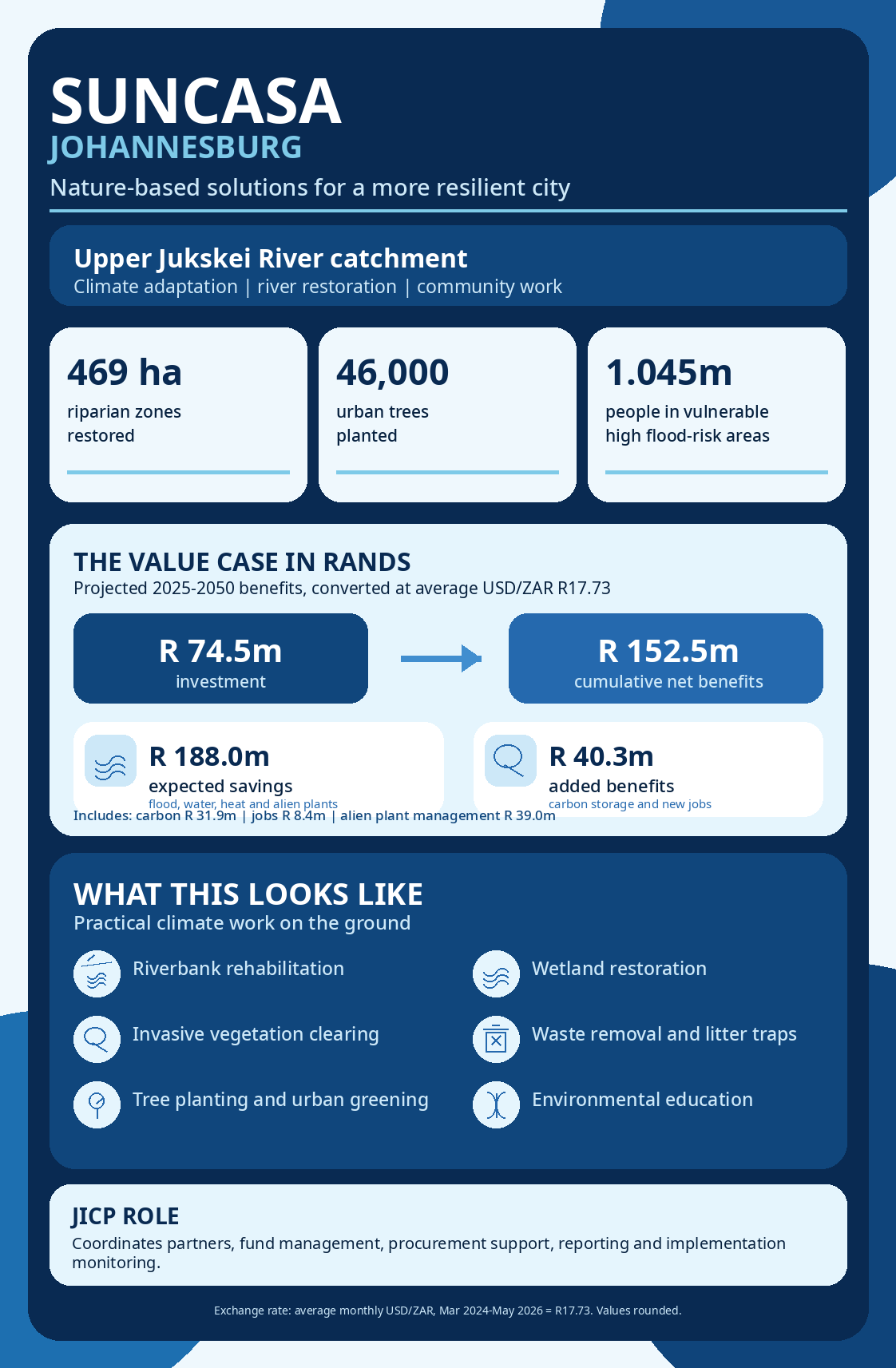
In Johannesburg, key targets include the restoration of approximately 469 hectares of riparian zones along the Upper Jukskei River catchment and the planting of approximately 46,000 urban trees across targeted communities and public spaces. The project aims to benefit approximately 1.045 million people living in vulnerable, high flood-risk urban areas.
Why it matters
SUNCASA shows how environmental restoration can also be social and economic regeneration.
Cleaner rivers improve health and safety. Restored riverbanks reduce flood risk. Tree planting improves shade, reduces heat stress and supports biodiversity. Better public open spaces create places for walking, gathering, playing and community life. Local environmental work creates income, skills and a stronger sense of ownership.
For JICP, SUNCASA also strengthens the link between climate adaptation and people-based urban regeneration. The programme demonstrates that nature-based solutions are not only about ecology. They are about dignity, resilience, livelihoods, safety and the everyday experience of the city.
Looking ahead
The lessons from SUNCASA are helping JICP expand its nature-based placemaking approach in the Johannesburg inner city.
This includes the development of Pocket Plazas on the Walkable Network: small public spaces that combine urban greening, seating, shade, public art, safety, walkability and climate resilience. These spaces are designed to show how nature-based solutions can be integrated into dense urban environments in ways that are practical, visible and people-centred.
JICP is currently exploring opportunities to implement an estimated 25 Pocket Plazas and welcomes partnerships and funding support to help expand this work.
An invitation to partner
SUNCASA demonstrates what becomes possible when environmental restoration, community participation and climate adaptation are brought together.
JICP invites public institutions, funders, businesses, environmental partners, community organisations and research institutions to work with us in strengthening nature-based solutions across Johannesburg.
The opportunity is to build a city that is greener, safer, more resilient and more liveable — not in theory, but through practical work on the ground.